
Estate planning can sound complicated.
Your job is to make it easier to understand.
You don't need to sound like an attorney, and you don't need to know the answer to every legal or tax question.
What you do need is the ability to explain the basics clearly enough that a family understands why it matters to them.
Use this page when you're looking for a simple way to explain a concept, answer a common question, or help a family understand the difference between the estate planning tools available to them.
YOUR ROLE. THEIR PEACE OF MIND
You are not giving legal or tax advice. You are educating, clarifying, and helping families understand their options.
You don't have to know everything. You do need to know when a question goes beyond your role and should be referred to the appropriate professional.
PRIMARY RESOURCE FOR YOU
This is your go-to field guide when you need help explaining estate planning in plain English. You'll find conversational ways to explain wills, trusts, probate, trust funding, ownership, beneficiaries, incapacity and decision-making authority, along with what you can say, what to avoid saying, and when it's time to refer a question for professional advice.
QUICK TEACHING TOOL
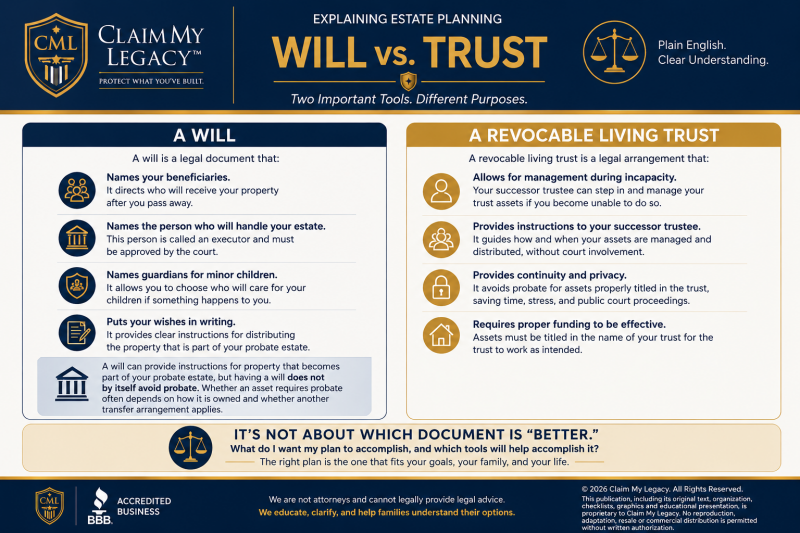
Will vs. Trust | Plain-English Comparison
Use this visual when a family is trying to understand the difference between a will and a revocable living trust.
Walk through it with them. The goal isn't to convince them that one document is “better.” Help them understand what each tool does, then bring the conversation back to what they told you they want their estate plan to accomplish.
HOW I WOULD SAY IT
If someone asks, “So is a trust better than a will?”, you don't need to make the decision for them.
Try:
“I wouldn't look at it as one being better than the other. They do different things. What matters is what you want your estate plan to accomplish for you and your family. Let's look at the differences together.”
Then use the comparison above.
Ask. Explain. Then listen.
CLIENT EDUCATION TOOLS
Sometimes the best thing you can do is give the family something they can read after your conversation.
Use these approved Claim My Legacy resources when a family wants to learn more:
Send the family the current resource link rather than an old PDF you've saved to your computer. That way you're always giving them the most current CML material.
PUT IT INTO PRACTICE
Pick one estate planning concept from the field guide that you sometimes struggle to explain.
Read the plain-English explanation.
Then close the guide and explain it out loud in your own words, as though a family were sitting across from you.
If it still sounds complicated, simplify it again.
The goal isn't to sound like an estate planning expert. The goal is for the family to understand.
USE CURRENT APPROVED MATERIALS
Always use the current version available in the Legacy Specialist Resources™ center rather than previously saved or downloaded versions.